Homeschooling a large family can be a daunting task, but it doesn’t have to be. Once you figure out how and what you want your family to learn, the path becomes clear and the excitement begins. Let’s dive in!
In this large family homeschooling guide, we’ll cover . . .
- How to school — separately or together? — and perks of both
- Combining subjects were you can
- Consider a meal time basket
- Hands-on and real-life learning
- Homeschooling with little ones underfoot
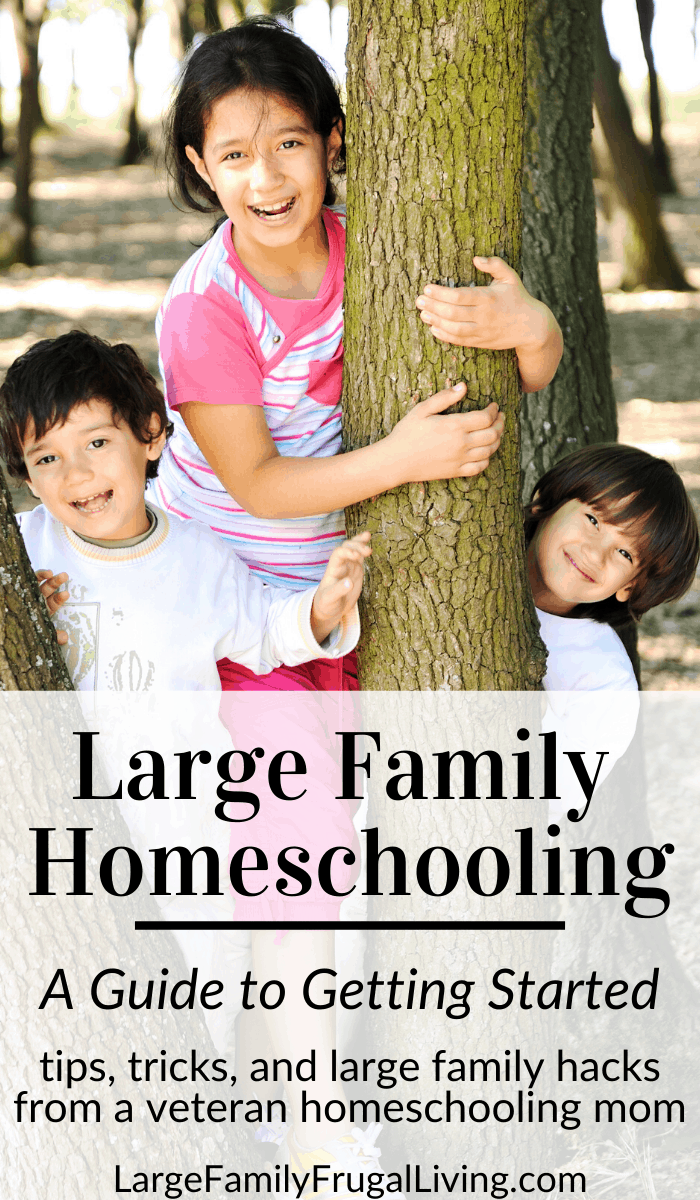
Homeschool together or separately?
Deciding to do schoolwork together or separately will largely depend on the curriculum you use. Using something with separate grade levels like Abeka or Rod and Staff would naturally incline you to help your children with their studies separately. Whereas taking a unit study approach would lead to more gathered schooling.
If you aren’t sure which approach to take, I highly recommend Cathy Duffy. She has been reviewing curriculum for the homeschooling community since the ’80s. You’ll also find reviews of resources for those interested in homeschooling, education, the origins debate, and related political and spiritual topics.
In our decade of homeschooling, we’ve tried many different homeschooling methods — literature-based, workbooks, textbooks, online, unschooling, unit studies — we’ve pretty much done it all. And while some methods worked better for different children (my 18-year-old would much rather have a workbook than read a living book), we always return to family-style learning in the end.
Family-style learning
A little family background . . . My children are currently aged 4, 6, 8, 9, 18, and 21. The 21-year-old graduated from our homeschool and my 18-year-old will be a senior in the fall. (Where did the time go???) As a senior, she is a completely independent learner. She still sits with the rest of us wherever we are and listens to me read, helps the other children if they ask, and hangs around with us in general. She may have her laptop with her or her math books out, but she’s with us none the less.
That being said, as I write this, I am primarily schooling the 4, 6, 8, and 9-year-olds.
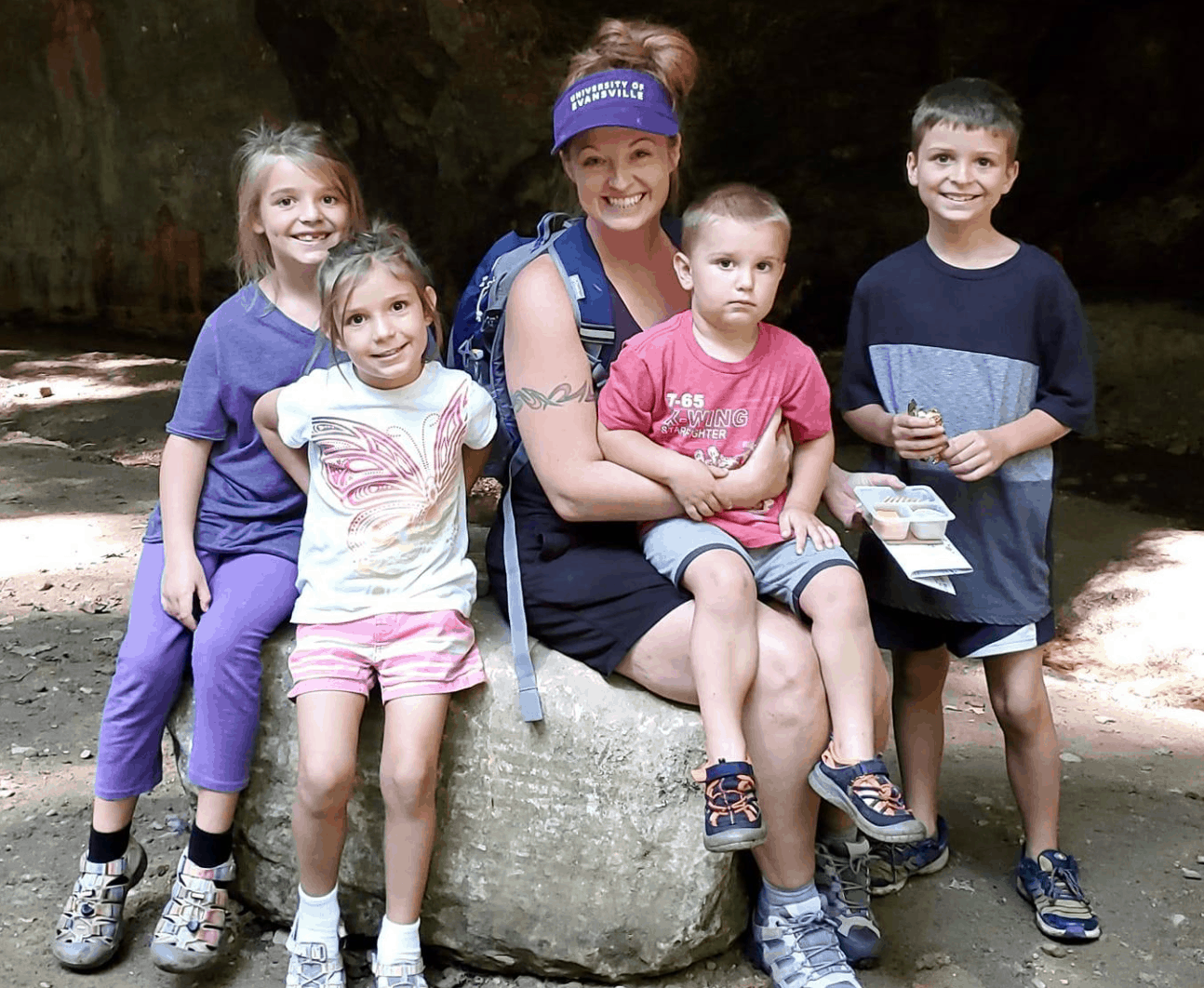
Learning together can take place anywhere – at the kitchen or dining room table, on the couch, at the park, on the front porch – the possibilities are endless. We’ve even been known to take some of our schoolwork with us to the dentist while they cycle through family members.
This is the best option for us right now because my four littles are so close in age. We’re currently using Gather ‘Round Homeschool and LOVING it. It’s a unit study type program, so it’s easily used by multiple ages at the same time.
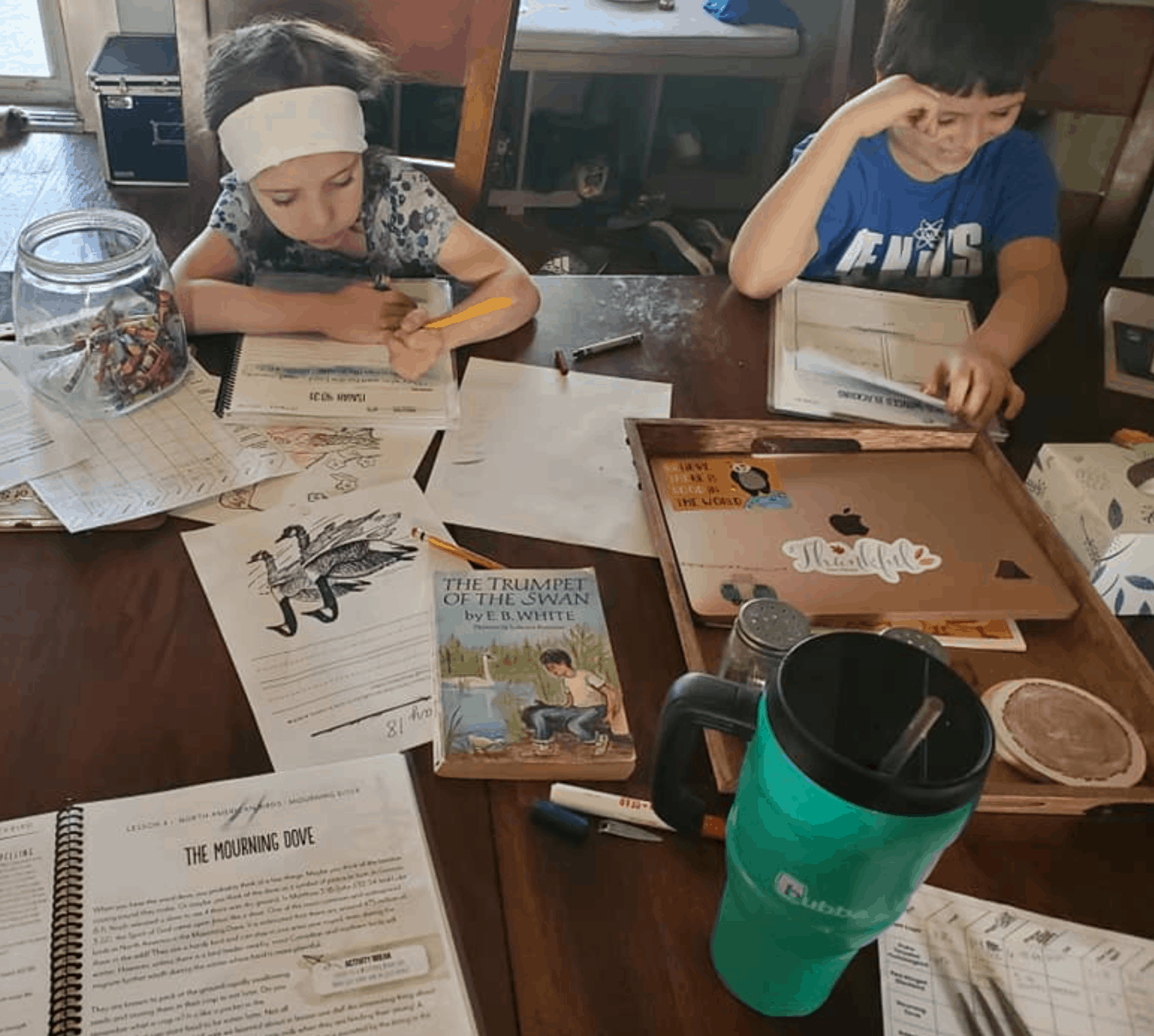
Our together time looks something like this . . .
- We always start with our catechism and whatever Bible study we’re doing. Right now we’re working through The Fruit of the Tongue from Not Consumed. This takes us about 20 minutes. Then it’s onto our unit study.

- I read from my teacher guide while the children listen and start filling in their notebooking pages.
- We go through the remaining pages together. Gather ‘Round works 9 different subjects (not math) into their studies. The kids do a total of 4-5 pages of work and that’s it for the notebooks. This part usually takes about 45 minutes to an hour to do together. We take our time and look things up, watch videos, listen to sound clips (we’re currently studying North American Birds), do hands-on activities, and follow whatever rabbit trail we fancy. If we’re done in 45 minutes, fine. If it takes us 2 hours, and the kids are enjoying what we’re doing, great.
- After our notebooks, we do some quick math drills, and I’ll read a chapter or two from our current read aloud. (Click here for a list of activities to keep the kids busy while you read aloud.)
That’s it!
Sometime during the day, the older two read a chapter or picture book and fill out their Reading Journal, and I’ll read books with the younger two.

Some of our favorites are . . .
- The Scrambled States of America
- Match a Leaf
- Match a Pair of Birds
- Sherlock (It’s not what you think and it’s SUPER fun. There’s no reading required so all the kids can play.)
So that’s basically what our family-style homeschooling looks like. Now let’s take a look at what more individualized learning might look like.
Individual or Separate Learning
There have been years when we did Abeka, Heart of Dakota, or just a mishmash of individual courses for the kids (when my eldest two were middle school age). While this worked fine for them, it was hard on me. I had to basically put in a full school day (2-3 hours) with EACH kid. I didn’t outsource anything at the time, and none of their work was online.
That meant that I was responsible for getting everything together, making lesson plans, and keeping up with where they were in each subject. It wasn’t hard, but the initial set up was pretty mom intensive.
If you plan to do individual learning, I recommend using something that already has lesson plans done, or maybe using an online program or two, especially when you have 3, 4, or 5 school-age kids. Having a student planner is a big help, too.
One of the perks to individual learning is that they aren’t held back by their sibling’s behavior or questions. When we’re doing our unit study, the whole thing gets put on hold to answer questions, listen to thoughts, or deal with behavior or attitude issues. This can be frustrating for everyone. Not so with separate work.
Separate work also allows your student to work further ahead in the material, maybe they want to get a few days worth of schoolwork done so they can have a 4 day weekend.
If you live in a state that has rigorous requirements, individual learning naturally allows for easier record keeping. That’s not to say that you can’t keep records with family-style learning, you just have to be a bit more creative.
Combine Subjects were you can
Some subjects (language arts and math) are skill dependant. These are the subjects that you have to teach in a certain order, making sure your child understands one concept before you move on to the next. Other subjects are topical, meaning you just pick a topic and learn about it. These are easily used for multiple ages.
Some subjects we have combined for multiple ages over the years . . .
- Bible
- History
- Geography
- Science (until the high school years)
- Music study
- Nature study
There are a plethora of good resources for these subjects. Again, check out Cathy Duffy’s site. You can do an advanced search for curricula that specifically meet your needs, i.e. grades 2, 5, and 7/science/young-earth belief.
Consider a meal time basket
You’ve heard of a morning basket or circle time, right? It’s the same thing but we use it at mealtimes instead of in the morning. We gather for meals and are seated around the table for at least 2 1/2 hours a day, why wouldn’t you capitalize on that???
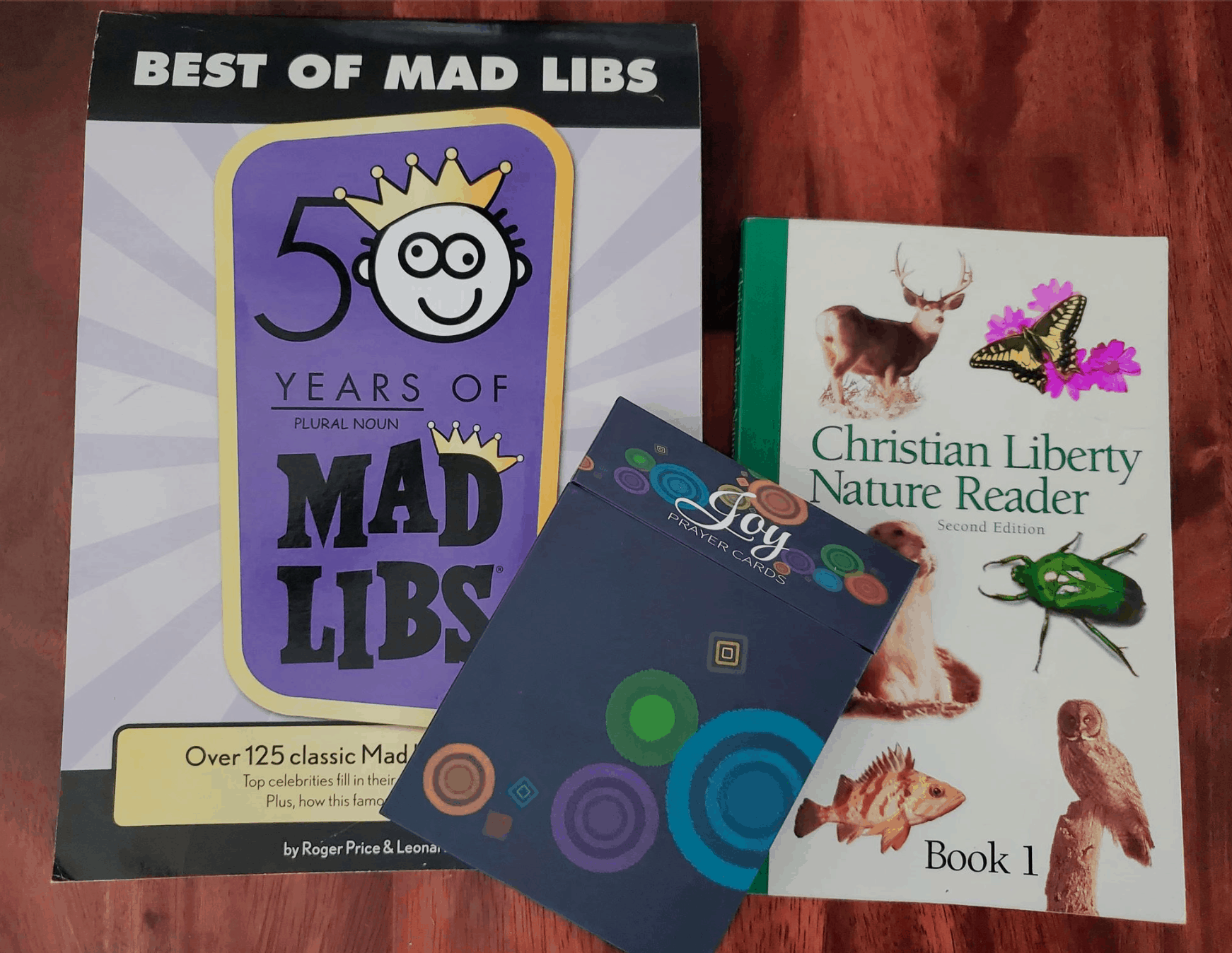
Inside our meal time basket, I keep the little things I’d like to add in but don’t usually get time for during regular schooltime.
- Mad Libs – these are so fun and it’s great grammar exercise for the kids
- poems – I like to have a “poet of the month” and I’ll keep books about and by the author in there
- Christian Liberty Nature Readers
- JOY Prayer Cards
- memory work – whatever verse we’re working on, our address or phone number, anything else we’re working memorizing
Hands-on and real-life learning
Schoolwork goes way beyond the dining room table. It travels to the kitchen, to the forest, around the world! There are so many ways for children to learn that do not require a book- or a chair.
- No Sweat Nature Study – this is a great no-stress way of getting nature study done. I love Cindy West’s classes, they’re great for all ages
- cooking together in the kitchen
- planting and maintaining a garden
- working on vehicles with Dad
- learning to sew
- life skills like learning to keep a home, do laundry, prepare meals
- take field trips- both real and virtual
- volunteer somewhere
Don’t ever think learning has to take place at a table, or that you have to have “proof” that your child is learning. The proof will be in their conversations and play.
Homeschooling with little ones underfoot
Have you ever heard that the biggest obstacle in homeschooling is the children? I’m joking! Mostly…
But seriously, schooling with toddlers and babies is far from easy. Here are a few tips for large family homeschooling with little ones underfoot.
Spend some one on one time with the littlest ones first. Fill their little love tanks before you begin school with the bigger kids. That way they’re more inclined to play independently and not feel like they’re missing out.
Use naptime for focused learning or messy school work like science experiments. Naptime is the perfect time to do all the things you’d rather do without little hands around.
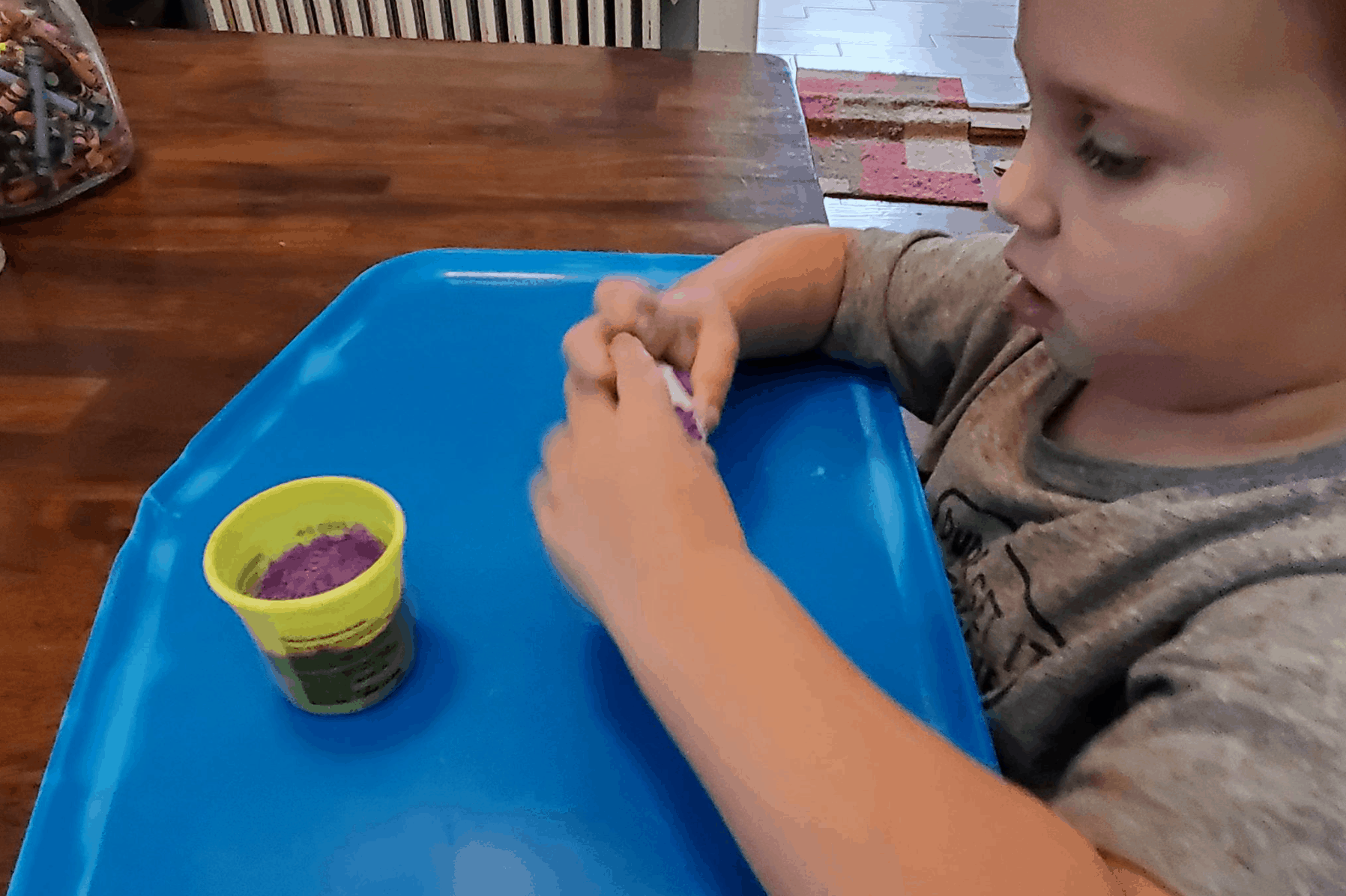
I love these craft trays. We use them all the time!
Make some special school time only toy bins. I take those plastic shoe boxes from the Dollar Tree and put “special” toys or art supplies in them that are only allowed to be played with while the bigger kids are doing school. Playdough, little cars, coloring books and crayons, watercolors, sensory toys, anything really. . . Once you call something “special” it makes them want to play with it more– which leads to them sitting still, at least for a little while.
Older children helping with younger children. Many times over the years, I’ve called on an older sibling to have “sibling time” with one of the babies or toddlers while I work with the middle kiddos. It works well for all involved. The younger kids get some school done, the older one gets a welcome school break, and I can not have to worry about where the toddler is for a full 30 minutes.
You can do this, Mama! Leave any questions in the comments below!
Looking for more posts to help establish your homeschool days?
Plan Your Days with Gentle Productivity Part 1
Plan Your Days with Gentle Productivity Part 2
Daily Homeschool Routine (an old routine from a couple of years ago)